Projects

Terrestrial Gamma-ray Flashes & Lightning Dynamics
Terrestrial Gamma-ray Flashes (TGFs) are brief, intense bursts of gamma radiation originating within thunderstorms, believed to be produced by Relativistic Runaway Electron Avalanches (RREA) during lightning leader propagation. This research examines connections between TGFs and lightning processes using a multi-instrument detection system in Delta, Utah.
Detection Instruments
- VHF Interferometry (INTF) — Lightning channel imaging
- Fast Antenna (FA) — Electric field measurements
- Surface Detectors (TASD) — 507-detector gamma-ray array
- High-speed Photometry — Multi-channel optical measurements at 337nm, 391nm, 777nm
- Spectroscopy — Wavelength-resolved lightning emissions
My Contribution
My primary contribution is the Loyola Lightning Machine, a multi-instrument desktop GUI built in Python and tkinter that unifies all five instrument streams into a single analysis environment. Before this tool existed, each instrument's data was processed separately with one-off scripts and manual re-calibration for every event. The GUI standardizes data loading, time alignment, and calibration across instruments, and embeds interactive matplotlib plots directly into each analysis tab.
Beyond software, I am involved in the physical data collection and upkeep of the detection station in Delta, Utah. This includes travel to the site during storm season, instrument maintenance, and ensuring the system is operational before and during events. Data from the 2024 and 2025 storm seasons forms the basis of the current analysis.
qNoise — Quantum Hardware Noise Characterization
View the live qNoise dashboard →
I had a general interest in Quantum Computing for a while, and decided to make a small scale self-project to learn about the available infrastructure, have experience developing some code, and better my understanding of QC fundamentals. I developed a semi-automated pipeline to characterize noise on real quantum hardware and benchmark quantum compilation strategies. Every data point was measured on IBM's ibm_fez superconducting processor. The question I'm trying to answer: does Infleqtion's Superstaq compiler create circuits that perform better on noisy hardware than Qiskit's default optimizer?
What It Measures
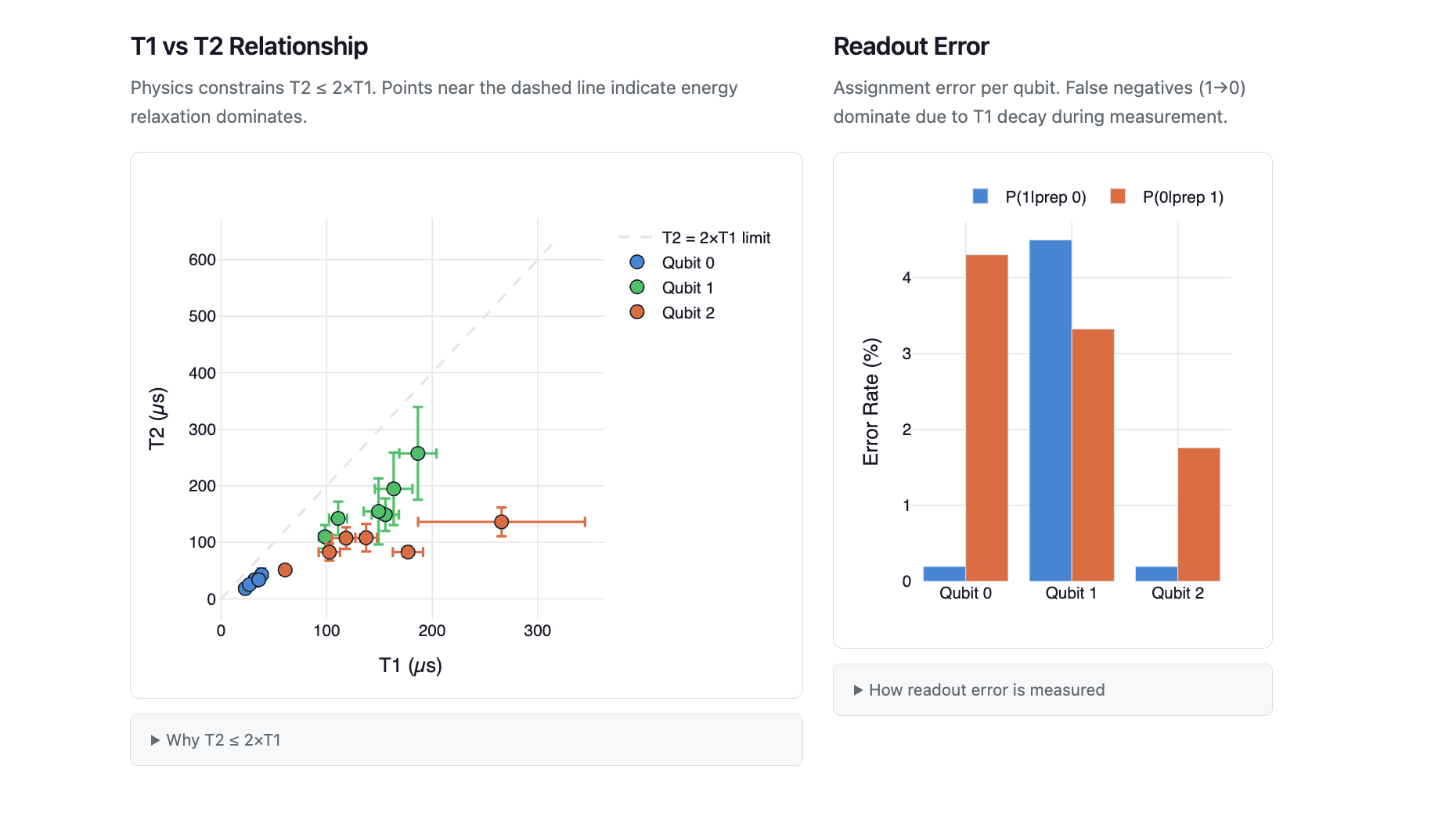
- T1 (Energy Relaxation) — How long a qubit holds the |1⟩ state before decaying
- T2 (Coherence, Hahn Echo) — How long a qubit maintains quantum superposition
- Readout Error — Measurement confusion matrix for each qubit
- Compilation Fidelity — Hellinger fidelity of Qiskit vs Superstaq compiled circuits on real hardware
Key Finding
Qubit noise properties drift significantly over hours. T1 values ranged from 23 to 266 µs across runs, and qubit rankings flipped entirely within 2.5 hours. In compilation benchmarks, Superstaq achieved higher fidelity on QFT circuits despite deeper compiled depth, by minimizing two-qubit gate count, the dominant error source on superconducting hardware.
Python 3.12 · Qiskit 2.3 · qiskit-ibm-runtime (SamplerV2) · qiskit-superstaq · SQLAlchemy · SciPy · Plotly · IBM Quantum